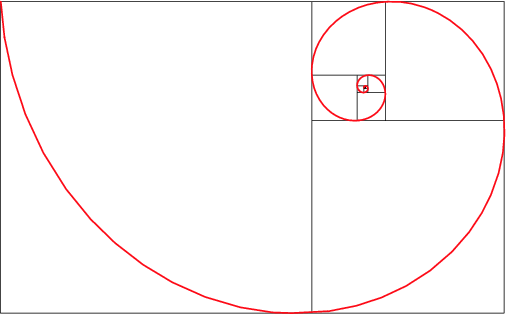
In chapter 4 of my book I talk about a rectangle inscribed within a circle. Naturally there are an indefinite number of such figures. Take the diagram on the right, kindly produced by Michael Schneider. Look at the outermost circle, and the largest rectangle that lies inside it, touching its circumference at A, B and C. You could move points A and B nearer to the left-hand end of the horizontal diameter of the large circle, or else push them further apart towards the two ends of the vertical diameter, producing an ever-thinner oblong shape. Halfway between these extremes the rectangle would become a square. But the shape Michael has drawn is a Golden Rectangle, so we can call the whole figure a Golden Circle ("Golden" because of the presence of the Rectangle). The G.R. is famous for being the "most beautiful" of rectangles, possessing the peculiar property that its sides are in the ratio of 1 to Phi (1.618...), so that if you cut off a square portion what remains is a smaller Golden Rectangle - and so forth, forming a logarithmic spiral, as in the following image.
When I wrote the book I was intending to use the Golden Circle as a way of exploring the relationship between Pi and Phi, but I never got around to it. My reason for being intrigued is simple. What we learn from Simone Weil - and what she learned from the Greeks - is that geometry is full of theological meaning. We have forgotten how to make those connections. It is not that we can prove the Trinity or the Incarnation with diagrams, but that the mathematical world is full of analogies that echo theological and spiritual truth. You might even say that mathematical necessities are a portrait of divine freedom, since in God freedom and necessity coincide. The beauties of geometry and arithmetic are a world of metaphors and help to raise our minds towards the contemplation of divine truth. My book only touches on this, but a much fuller and richer account is given by Vance G. Morgan of Providence College in his book Weaving the World: Simone Weil on Science, Mathematics and Love, reviewed here.
Showing posts with label Weil. Show all posts
Tuesday, June 15, 2010
Saturday, November 21, 2009
The Pope on Beauty
The "way of beauty" is the theme of the Pope's recent address to artists on 21 November 2009 in the Sistine Chapel. In it he writes - quoting both Hans urs von Balthasar and Simone Weil, who are influences on the book on which this blog is based (see left), and building on the Letter to Artists of Pope John Paul II - as follows: "Beauty, whether that of the natural universe or that expressed in art, precisely because it opens up and broadens the horizons of human awareness, pointing us beyond ourselves, bringing us face to face with the abyss of Infinity, can become a path towards the transcendent, towards the ultimate Mystery, towards God.... In this regard, one may speak of a 'via pulchritudinis,' a path of beauty which is at the same time an artistic and aesthetic journey, a journey of faith, of theological enquiry.... Simone Weil wrote in this regard: 'In all that awakens within us the pure and authentic sentiment of beauty, there, truly, is the presence of God. There is a kind of incarnation of God in the world, of which beauty is the sign. Beauty is the experimental proof that incarnation is possible. For this reason all art of the first order is, by its nature, religious.'"
The Pope has also recently spoken very eloquently of the beauty of the medieval cathedrals, one of which, the Cathedral of Orvieto, is featured in the photograph. There he speaks of "a much broader form of reason, in which the heart and reason come together. This is the point. This, I think, is in some way the proof of the truth of Christianity: the heart and reason come together, beauty and truth touch. And to the extent that we are able to live in the beauty of truth, so much more will faith again be able to be creative, in our own time as well, and to express itself in a convincing artistic form."
Subscribe to:
Posts (Atom)