
Friday, January 13, 2012
Through the Eyes of Faith

Friday, January 6, 2012
Self-creation
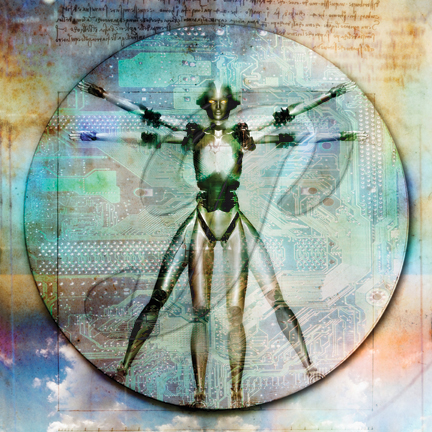
"Even though manned spaceflight will be a diminishing priority for governments, I believe and hope that some people now living will walk on Mars (though they may well go with one-way tickets). Moreover, a century or two from now, intrepid adventurers may be living independently from the Earth. Whatever ethical constraints we impose here on the ground, we should surely wish such pioneers good luck in genetically modifying their progeny to adapt to alien environments.
"Indeed, this might be the first step towards divergence into a new species: the beginning of the post-human era. Meanwhile, machines of human-like intelligence could spread still further into the stars. Whether the distant future lies with organic post-humans or with such intelligent machines is a matter for debate – but these prospects remind us that we may be near the beginning of a cultural and technological evolution that will continue not only here on Earth, but far beyond."The emphasis is mine. Meanwhile, one of the most horrifying articles in a
recent issue of the RSA Journal is called "Self-Created". It comes from a "transhumanist" who predicts:
"we will modify ourselves to work in a way that is smarter, better and faster. History is the story of human liberation, and design will take us to a new frontier whereby we can liberate ourselves from our very identities... To self-design will be to self-create. New jobs will arise, and modifications will become conditions of employment."He concludes: "Self-modification will start as tragedy. There will be sad grotesques. But with the tools and the intent, we can design our own personalities. The definition of ‘human’ will expand. Our children’s children will look nothing like us. And that will be by design."
The article exemplifies an attitude that is increasingly common in a secular age, where a sense of the sacred has become attenuated or distorted or lost altogether. If we are merely the material products of evolution, why not take over from the blind accidental processes of natural selection and design ourselves to be the way we'd like to be? What could be wrong with that? Sure, there will be some collateral damage – what the article calls "sad grotesques" – but you can't make an omelette without breaking eggs.
It is an attitude founded in the fantasies of the ego. Against it stands an attitude founded in reality – the reality of the world and of human nature. The world comes from a mysterious source over which we have no control. It is sheer gift. Conscious life, too, comes from this same mysterious source of Being, which cannot therefore be less than conscious itself. The profound reasons why science and technology should not ignore or usurp this "source", reducing organism to artifact, are laid out in a paper by Michael Hanby, from the Summer 2011 issue of Communio.
Monday, January 2, 2012
Pope on education
The Pope's Message for the World Day of Peace (1 Jan.) this year is titled "Educating Young People in Justice and Peace", and section 3 in particular contains some luminous passages summarizing the Pope's fundamental message to the modern world. For example:
"Man is a being who bears within his heart a thirst for the infinite, a thirst for truth – a truth which is not partial but capable of explaining life’s meaning – since he was created in the image and likeness of God. The grateful recognition that life is an inestimable gift, then, leads to the discovery of one’s own profound dignity and the inviolability of every single person.... Only in relation to God does man come to understand also the meaning of human freedom. It is the task of education to form people in authentic freedom. This is not the absence of constraint or the supremacy of free will, it is not the absolutism of the self. When man believes himself to be absolute, to depend on nothing and no one, to be able to do anything he wants, he ends up contradicting the truth of his own being and forfeiting his freedom. On the contrary, man is a relational being, who lives in relationship with others and especially with God. Authentic freedom can never be attained independently of God."
The Message also contains a link to another text from 2005 where Pope Benedict summarizes the "theology of the body" and of the family. Both are worth reading in full.
Saturday, December 31, 2011
2012: probably NOT the end of the world
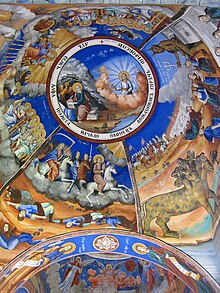
Of course, this kind of speculation will not convince or even interest most people, but some would like to go further and explore the prophecies of the Book of Revelation, comparing these to the messages of the various apparitions and visionaries approved by the Church (Fatima, La Salette, and so on). For those readers, Emmett O'Regan's book Unveiling the Apocalypse will be a delight. In it he even goes in some depth into the ancient number symbolism of the Bible, called Gematria. His website (follow the link I just gave) gives further material and offers a sample chapter of the book. Some of these topics, such as Gematria, also come into my book All Things Made New, although unlike O'Regan in my "spiritual" interpretation of the Apocalypse I don't refer to extra-scriptural prophecies and I don't come to conclusions that relate to specific dates and historical events.
Illustration: Fresco from Osogovo Monastery, Macedonia (Wikimedia Commons)
Tuesday, December 27, 2011
A mystic in New York
 |
| "Remember" |
works, and keeps them permanently on display. It is also a cultural centre, offering free concerts and poetry readings. The museum itself is a lovely building to visit and beautifully designed and kept.
 |
| "Kiss to the Earth" |
"Where can one have such joy as when the sun is upon the Himalayas; when the blue is more intense than sapphires; when from the far distance, the glaciers glitter as incomparable gems. All religions, all teachings, are synthesized in the Himalayas." – extracts from Shambhala.
Friday, December 23, 2011
What's in a landscape?

nineteenth century, and they all tended to work outdoors. They loved the forests, the plains, the rivers, the mountains of Canada, and would take off into the wilderness with a sketchbook small enough to carry in a canoe or a backpack, capturing what they could usually as far from human habitation as possible. As a formal group they exhibited between 1920 and the year they disbanded, 1933.

Next: Nicholas Roerich.
Pictures: Tom Thomson, "Autumn's Garland"; Lawren Harris, "Mount Lefroy"
Wednesday, December 21, 2011
Social network
Billed as the "social network of the JP2 and B16 generations", Ignitum Today seems well worth a visit.
Subscribe to:
Posts (Atom)